
Why Your AC Stopped Cooling — and What to Check Right Now
If you’re dealing with ac not cooling properly what to check, here’s a quick overview of the most common culprits to inspect before calling a technician:
- Thermostat settings — Make sure it’s set to COOL mode and the temperature is below the current room temperature
- Air filter — A dirty or clogged filter is the single most common cause of poor cooling
- Circuit breakers — Check both the indoor air handler and outdoor condenser circuits
- Outdoor condenser unit — Look for debris, overgrown vegetation, or dirty coils blocking airflow
- Air vents and registers — Confirm all vents are open and unobstructed
- Evaporator coil — Check for ice buildup, which signals an airflow or refrigerant problem
- Condensate drain line — A clog here can trigger a safety shutoff and kill cooling entirely
- Refrigerant lines — The copper lines running to your outdoor unit should feel cold and show light condensation when the system is working properly
When your air conditioner is running but your home still feels like a sauna, it’s one of the most frustrating things a homeowner can deal with — especially during a Mid-Atlantic summer when temperatures in Maryland, West Virginia, and Pennsylvania can climb well into the 90s. The good news is that most AC cooling problems come down to a short list of common issues, and many of them are things you can check yourself in under an hour without any special tools.
This guide walks you through a clear, step-by-step troubleshooting process — from the simplest fixes to the signs that it’s time to pick up the phone and call a professional. You’ll know exactly what to look at, what normal looks like, and when to stop tinkering and let an expert take over.
I’m Merle Vaughn, a Master HVAC license holder in Maryland and West Virginia with 20 years of hands-on experience diagnosing exactly the kind of ac not cooling properly what to check scenarios we’ll cover here. Let’s start with the basics and work our way through the system so you can get your home comfortable again as quickly as possible.
AC Not Cooling Properly? What to Check First
When the heat of April 2026 starts to settle into areas like Hagerstown, MD, or Martinsburg, WV, the last thing you want is a cooling system that’s just moving lukewarm air around. Before you panic, we recommend a “detective” approach. Think of your AC like a car or a computer; sometimes the fix is as simple as a flipped switch or a dead battery.
The first thing to understand is that your central air conditioner relies on two separate electrical circuits. One powers the indoor air handler (the blower that moves air through your ducts), and the other powers the outdoor condenser (the big unit outside that releases heat). If the indoor fan is blowing but the outdoor unit isn’t running, you’ll get air movement without any actual cooling.
Is Your Thermostat the Reason Your AC is Not Cooling Properly? What to Check
It might sound too simple, but we see it all the time: the thermostat is the “brain” of your HVAC system, and if the brain is confused, the body won’t work.
- Check the Mode: Ensure the thermostat is set to “Cool.” It’s surprisingly easy for a family member to accidentally bump it to “Heat” or “Off” while cleaning or passing by.
- The 5-Degree Rule: Set the cooling temperature at least 3 to 5 degrees below the current room temperature. If it’s 75°F in the house and the thermostat is set to 74°F, the system might not kick on immediately.
- Fan Settings (Auto vs. On): If your fan is set to “On,” the blower runs constantly, even when the AC isn’t actually cooling the air. This can result in lukewarm air blowing through your vents between cooling cycles. Setting it to “Auto” ensures the fan only blows when the air is being actively chilled.
- Battery Power: If your thermostat has a blank screen or a low-battery warning, replace the batteries immediately. A weak battery can prevent the thermostat from sending the “start” signal to your outdoor unit.
- Tripped Breakers: Check your home’s main electrical panel. Air conditioners pull a lot of power, especially during the first heatwave of the year. If you find a tripped breaker, flip it all the way to “Off” and then back to “On.” If it trips again immediately, do not reset it a second time—this indicates a serious electrical fault that needs a pro.
If you’ve checked these basics and still aren’t feeling the chill, you might need to dig a little deeper into local expertise. For those in Pennsylvania, learning how to find the best AC repair in Shippensburg, PA without losing your cool can save you hours of searching.
Airflow and Filtration: The Silent Cooling Killers
If we had to name the #1 enemy of home comfort, it would be the dirty air filter. A dirty filter is the single most common cause of AC problems we encounter from Frederick, MD, to Charles Town, WV.
When a filter is clogged with dust, pet hair, and dander, it restricts the amount of air flowing over the indoor evaporator coil. Without enough warm air passing over it, the coil gets too cold and the humidity in the air turns to ice. Once that coil is encased in a block of ice, it can’t absorb any more heat, and your AC stops cooling entirely.
Airflow Obstructions: AC Not Cooling Properly? What to Check Inside Your Home
Airflow issues aren’t always located at the filter. To ensure your system can breathe, perform a quick “airflow audit” of your home:
- The 30 to 90-Day Rule: Standard 1-inch pleated filters should be replaced every 30 to 90 days. However, if you have pets or allergy sufferers in your home, you should check them monthly.
- Check the Registers: Walk through every room and make sure the supply vents (where the cold air comes out) are wide open.
- Furniture Placement: Ensure that large sofas, rugs, or curtains aren’t blocking your return air vents. Your AC needs to “inhale” the warm air in your house just as much as it needs to “exhale” cold air.
- The “Closed Room” Myth: Some homeowners believe closing vents in unused rooms saves money. In reality, this increases pressure in your ductwork and can actually cause the evaporator coil to freeze or the blower motor to burn out. Keep at least 80% of your vents open at all times.
- Frozen Coils: If you see frost on the copper lines near your indoor unit or notice water pooling around the furnace base, your coils are likely frozen. Turn the AC off immediately and set the fan to “On” to help the ice melt. Do not try to scrape the ice off, as you could puncture the delicate fins.
Regular maintenance is the best way to prevent these “silent killers” from taking down your system. Residents in Pennsylvania can benefit from our guide on Chambersburg AC Maintenance: Don’t Let Your Unit Lose Its Chill to stay ahead of the heat.
Inspecting the Outdoor Condenser and Electrical Components
Now, let’s head outside. The outdoor unit (the condenser) is responsible for releasing the heat collected from inside your home. If it’s smothered by weeds or caked in dirt, it can’t do its job.
The 2-Foot Perimeter Rule
For your condenser to work efficiently, it needs plenty of “breathing room.” We recommend maintaining at least a 2-foot clearance around the entire unit and at least 5 feet of clear space above it.
- Clear the Debris: Remove tall grass, weeds, fallen leaves, or even children’s toys that may have gathered around the base.
- Clean the Coils: Over time, the metal fins on the outside of the unit get coated in pollen, dust, and lawn clippings. With the power off, you can gently rinse these fins with a garden hose (don’t use a pressure washer, as it will flatten the delicate metal fins).
- Check the Disconnect: Most outdoor units have a small metal “disconnect” box mounted on the wall nearby. Ensure the switch inside is in the “On” position. Sometimes yard work or curious animals can accidentally knock these out of place.
Electrical Failures and Component Wear
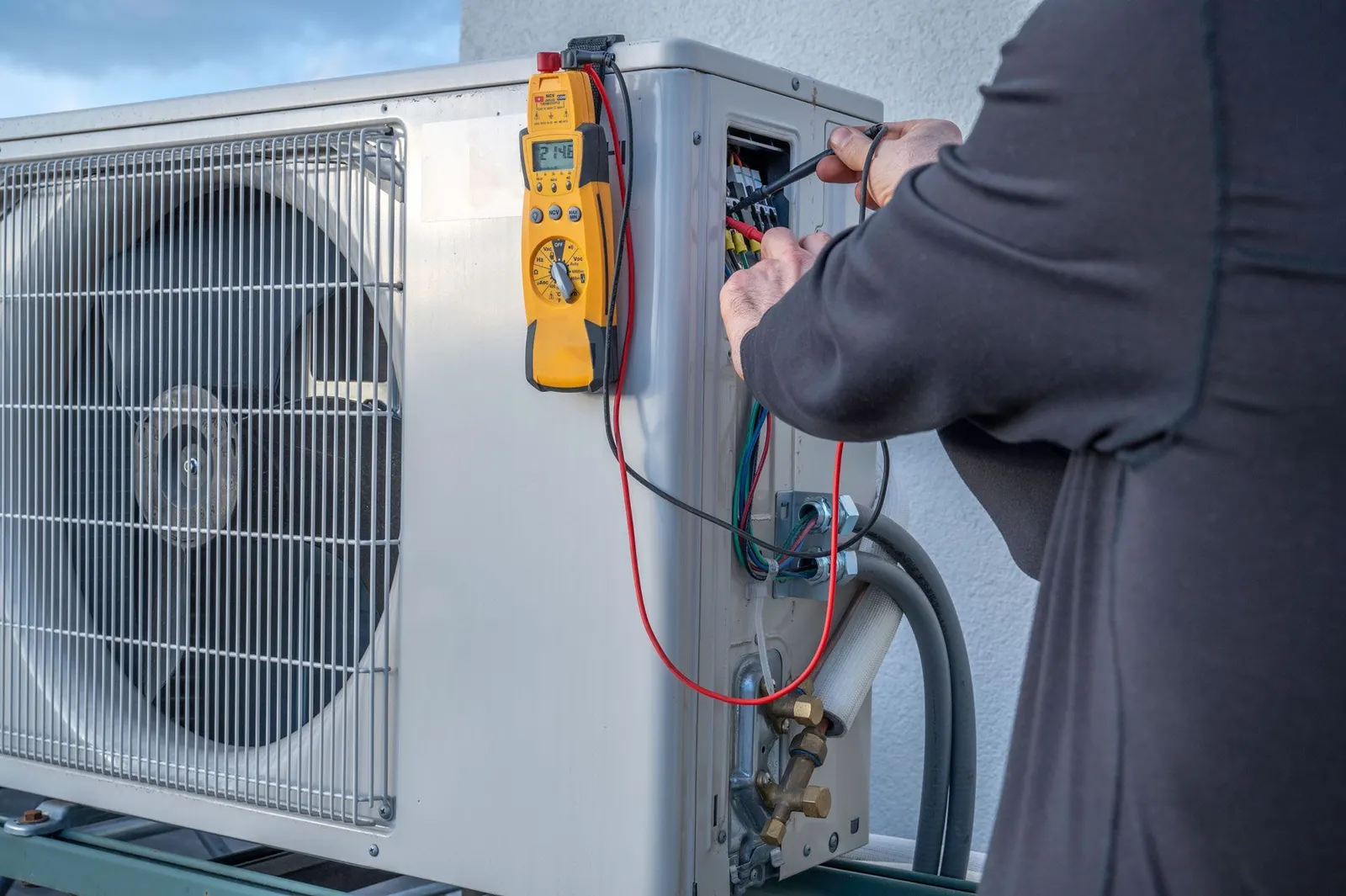
If the outdoor fan isn’t spinning or you hear a distinct “humming” or “clicking” sound coming from the unit, you might be dealing with a component failure.
- Capacitor Failure: The capacitor is like a large battery that gives the motor the “kick” it needs to start. These are very common failure points, especially during high-heat periods. A professional capacitor replacement typically costs between $150 and $300 for parts and labor.
- Fan Motor Issues: If the unit is hot to the touch but the fan isn’t moving, the motor may have seized.
- Contactors: This is the switch that tells the unit to turn on. If it’s pitted or worn, the electrical connection won’t be strong enough to start the compressor.
For a deeper dive into local repair expectations, check out our Martinsburg AC Repair Guide for Homeowners or our Professional AC Repair in Chambersburg, PA: A Local’s Guide.
When Troubleshooting Hits a Wall: Signs You Need a Pro
We love a DIY-capable homeowner, but there are certain parts of an HVAC system that require specialized tools and licensing—specifically when it comes to electrical wiring and refrigerant. If you’ve checked your filters, thermostat, and breakers and the air is still warm, it’s time to call in the experts.
| Symptom | Likely Issue | DIY or Pro? |
|---|---|---|
| Warm air blowing, filter is clean | Low Refrigerant / Leak | Pro Required |
| Hissing or bubbling noises | Refrigerant Leak | Pro Required |
| Unit hums but fan won’t spin | Bad Capacitor or Motor | Pro Required |
| AC won’t turn on at all | Electrical / Wiring Fault | Pro Required |
| Water leaking from ceiling | Clogged Drain / Pump Failure | Pro (Recommended) |
| Ice on outdoor copper lines | Airflow or Refrigerant Issue | Check Filter, then Pro |
Critical Warning Signs
- Refrigerant Leaks: Your AC does not “use up” refrigerant like a car uses gas. It is a closed loop. If the level is low, you have a leak. Adding more without fixing the leak is a temporary and expensive band-aid.
- Compressor Failure: The compressor is the “heart” of the system. If it fails, it is often a major repair. In older systems, this is often the point where we discuss Everything You Need to Know About AC Installation in Hagerstown rather than pouring money into a failing unit.
- Undersized Systems: If your AC runs 24/7 and never reaches the set temperature, it might be improperly sized for your home’s square footage or insulation levels. This is common in older homes in Frederick or Harpers Ferry that have had additions built without upgrading the HVAC.
Frequently Asked Questions About Poor Cooling
What temperature difference should I expect between return and supply air vents? In a healthy system, you should see a 16 to 20 degree Fahrenheit drop. If the air entering your return vent is 75°F, the air coming out of your supply vent should be between 55°F and 59°F. If the difference is less than 16 degrees, your system isn’t removing heat efficiently.
How do I check for a clogged condensate drain line? Look at the white PVC pipe near your indoor unit. Most modern systems have a “float switch” (a small plastic device wired to the pipe). If the drain line clogs with algae or debris, the water backs up, lifts the float, and kills the power to the AC to prevent a flood. You can sometimes clear a minor clog with a wet/dry vacuum or by flushing the line with a bit of vinegar.
Why is my AC running but the house is still warm? High humidity can make 75°F feel like 80°F. If your AC is old or oversized, it might “short cycle,” meaning it cools the air quickly but doesn’t run long enough to remove the moisture. This leaves you feeling “cold and clammy.”
If you are in West Virginia and need a second opinion, finding the right AC repair company in Harpers Ferry is a great next step.
Conclusion: Keeping Your Cool with Comfort Central Inc
Navigating an ac not cooling properly what to check scenario doesn’t have to be a nightmare. By starting with the basics—your thermostat, your air filters, and your outdoor unit’s cleanliness—you can often solve the problem yourself and save the cost of a service call.
However, when the simple fixes aren’t enough, you need a team you can trust. At Comfort Central HVAC & Plumbing, we’ve been a family-owned and operated fixture in the community since 2006. We take pride in serving our neighbors across Maryland, West Virginia, and Pennsylvania with licensed, insured expertise. Whether you need a quick capacitor swap in Chambersburg or a full AC installation in Charles Town, WV, we prioritize your family’s comfort above all else.
Don’t spend another night sweating through a Mid-Atlantic heatwave. From Hagerstown to Martinsburg, we are here to ensure your home remains the sanctuary it’s meant to be.
Ready to restore your home’s chill? Explore our full range of Cooling Services or contact us today to schedule a professional diagnostic visit.