
Navigating AC Failures: Pinpointing the Root Cause of Cooling Issues
Your thermostat is set to 70 degrees, but the indoor temperature stubbornly hovers near 80, and only lukewarm air is blowing from the vents. When your cooling system struggles during peak heat, having reliable home maintenance tips and troubleshooting strategies at your disposal is the first step toward restoring comfort. The frustration of a sudden cooling failure is immediate, but jumping to conclusions without observing the symptoms can lead to unnecessary stress and expense.
The central decision point for any homeowner facing a malfunctioning air conditioner is determining whether the issue requires basic homeowner checks or if it is time to dispatch a professional service technician. Modern HVAC systems are complex networks of pressurized refrigerants, high-voltage electrical components, and sensitive control boards. While there are safe, practical steps you can take to assess the situation, crossing the line into technical diagnostics without proper training is both dangerous and counterproductive.
When general service troubleshooting and maintenance steps do not solve the problem, reaching out for professional HVAC services becomes the logical next step. This guide will walk you through objective criteria for evaluating your system’s performance. By understanding the root causes of common failures, you can make informed decisions about whether a simple repair will suffice or if objective technical data points toward a full replacement.
Safe Homeowner Checks: Filters, Thermostats, and Breakers
Before assuming your compressor has failed or your system is beyond repair, it is critical to perform a few safe, preliminary checks. Many service calls trace back to simple oversights that restrict airflow or disrupt the electrical supply. Here are the initial troubleshooting steps you can safely perform without crossing into licensed professional territory:
- Inspect and replace the air filter: A clogged air filter severely restricts airflow through the air handler. This forces the blower motor to work harder and can cause the indoor evaporator coil to drop below freezing, leading to a complete system freeze-up. If the filter is visibly coated in dust or pet hair, replace it immediately with a clean one.
- Verify thermostat settings and power: Check the thermostat display. If the screen is blank, replace the batteries if applicable. Ensure the system is set to “Cool” rather than “Heat” or “Fan Only,” and verify that the temperature setpoint is at least five degrees below the current room temperature. A thermostat that has lost its calibration or connection to the control board will fail to signal the outdoor unit to turn on.
- Check the electrical panel: Air conditioners draw a significant amount of electricity upon startup. A sudden power surge or an overworked motor can cause the dedicated circuit breaker to trip as a safety mechanism. Locate your electrical panel and look for a tripped breaker. If it has flipped, reset it once.
When to Stop Troubleshooting
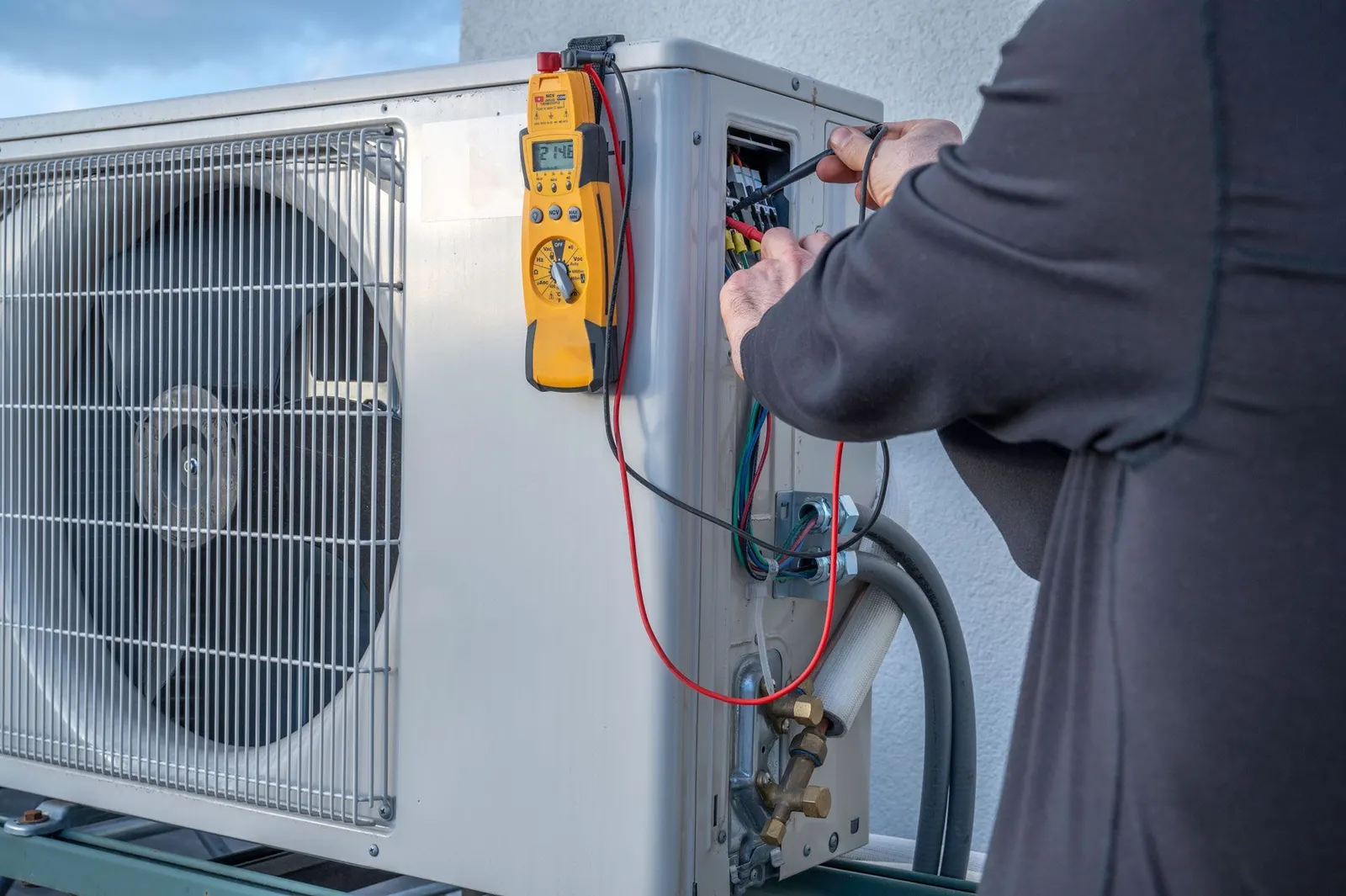
There is a definitive line where general service troubleshooting ends and professional intervention begins. If you run through these basic checks and the system remains unresponsive, do not attempt to open the electrical panel, remove the outdoor cabinet panels, or handle the refrigerant lines yourself.
Warning signs that require immediate professional attention include grinding or screeching noises from the outdoor unit, a burning electrical smell near the vents, or a circuit breaker that immediately trips again after being reset. Before you decide it is time to schedule your AC installation, let a licensed technician diagnose the true cause of the failure.
Diagnosing the Core Issue: Why an AC Runs But Fails to Cool
In our years of experience serving the local area, one of the most common patterns our team at our business sees during the summer months is an air conditioning system that sounds like it is running perfectly, yet fails to produce any cold air. This usually points to a breakdown in the heat transfer process. To understand why this happens, it helps to look at the primary components involved in cooling your home.
The Condenser Coil Breakdown:
The Problem: The outdoor unit is running, but the air inside remains warm.
The Cause: The condenser coil, located in the outdoor unit, is responsible for releasing the heat absorbed from inside your home into the outside air. If this coil becomes caked with dirt, pollen, grass clippings, or debris, it creates an insulating barrier. The heat cannot escape, and the refrigerant returns to the house still warm.
The Solution: While light debris can be brushed away, a deeply impacted coil requires professional chemical cleaning to restore proper heat transfer.
The Blower Motor Malfunction:
The Problem: The outdoor unit runs, but little to no air comes out of the indoor vents.
The Cause: The indoor blower motor is responsible for pulling warm air from your rooms, pushing it over the cold evaporator coil, and distributing the conditioned air back through the ductwork. If the motor capacitor fails, the fan belt breaks, or the motor itself burns out, the air distribution stops entirely.
The Solution: A technician must test the motor’s electrical draw and replace the faulty components to restore airflow.
The Refrigerant Leak:
The Problem: The system runs constantly, the air is mildly cool but not cold, and you may hear a faint hissing sound near the indoor unit.
The Cause: Air conditioners do not consume refrigerant; it circulates in a closed loop. If the system is low on refrigerant, there is a physical leak in the copper lines or the coils. Low refrigerant pressure also causes the indoor coil to freeze solid.
The Solution: Adding refrigerant without fixing the leak is illegal and ineffective. A professional must locate the leak, repair the brazed joints, and recharge the system to factory specifications.
Understanding these components gives you a solid foundation when discussing options with a technician, much like learning the core requirements of AC installation before committing to a major upgrade.
The Mid-Atlantic Climate Test: How High Humidity Strains Cooling Systems
Contextualizing AC performance requires looking at the specific environmental demands of your region. Based on what our team typically sees in the local area, the Tri-State climate presents a unique challenge. Summer temperatures are consistently high, but it is the humidity levels—frequently exceeding 60%—that truly test a cooling system’s capabilities.
An air conditioner performs two distinct jobs: sensible cooling (lowering the temperature) and latent cooling (removing moisture from the air). When warm, humid indoor air blows over the freezing cold indoor evaporator coil, condensation forms. This moisture drips into a drain pan and is channeled outside, effectively dehumidifying the house. However, this latent cooling process takes time.
This climate reality is why system sizing is so critical. A common misconception is that a larger, more powerful air conditioner will perform better. In reality, an oversized unit cools the ambient air temperature too quickly. It satisfies the thermostat and shuts off in just ten or fifteen minutes. Because the run cycle is so short, the system never has enough time to extract the heavy moisture from the air. The result is a home that feels cold but clammy—often described as a “cave-like” or “swampy” environment.
Furthermore, this frequent on-and-off cycling (short-cycling) puts immense strain on the compressor and electrical components, leading to premature wear and eventual system failure. In the Tri-State climate, precise sizing for optimal humidity control is non-negotiable for long-term comfort and equipment longevity.
System Lifespan and Efficiency: The 10-to-15-Year Timeline
When evaluating persistent cooling issues, the age of the equipment is a heavily weighted factor. According to data from the Department of Energy and ENERGY STAR, central air conditioners generally have an expected lifespan of 10 to 15 years. While exceptionally well-maintained units can occasionally push past this timeline, their efficiency drops significantly as internal components wear down.
Over time, the compressor valves lose their tight seals, fan motors draw more electricity to achieve the same RPMs, and the metallic coils suffer from micro-corrosion that inhibits heat transfer. Even if an older unit is still technically producing cold air, it is likely consuming substantially more electricity than it did during its first five years of operation.
Routine pre-season spring maintenance is the most effective way to extend this lifespan. A thorough cleaning, electrical calibration, and moving-part lubrication can prevent a majority of peak-summer system failures. However, maintenance cannot reverse the aging process or update obsolete technology.
Older units often rely on outdated refrigerants, such as R-22, which has been completely phased out of production due to environmental regulations. If an R-22 system develops a leak, the cost to repair and recharge it is often astronomically high. If your unit is nearing the 15-year mark and uses phased-out refrigerant, researching residential AC installation in Frederick or your specific local area can prepare you for the inevitable transition to a modern, high-efficiency system.
The Objective Repair vs. Replace Threshold
Homeowners frequently struggle with deciding when to stop pouring money into an aging air conditioner. Providing clear, unbiased criteria for this decision helps remove the emotion from the equation. Industry professionals often rely on objective metrics to weigh repair costs against the unit’s remaining viability.
One common metric is the “5,000 rule.” This is a simple mathematical baseline: you multiply the estimated repair cost by the age of the equipment in years. If the resulting number exceeds 5,000, replacing the unit is generally the more economical long-term choice. For example, a major compressor repair on a 12-year-old system will easily exceed this threshold, signaling that a replacement is the wiser investment.
Breakdown frequency is another critical indicator. If general service troubleshooting becomes a monthly necessity, or if you are calling for repairs multiple times in a single summer, the system is signaling that its core components are failing consecutively.
| Criteria | Lean Toward Repair | Lean Toward Replacement |
|---|---|---|
| System Age | Under 10 years old | Over 10-15 years old |
| Refrigerant Type | Modern (R-410A or newer) | Obsolete (R-22) |
| Repair Cost | Minor electrical or fan components | Fails the “5,000 Rule” (e.g., compressor failure) |
| Performance | Cools evenly and manages humidity well | Struggles with humidity, runs constantly, uneven cooling |
Ultimately, the team at our business is rooted in family values and honest home repairs, meaning we will always provide transparent diagnostics and objective advice. An honest technician will walk you through these metrics, helping you weigh the benefits of upgrading to a modern, high-efficiency system versus patching an obsolete one, rather than pushing an unnecessary replacement.

Preparing for a New System: The Importance of Manual J Sizing
If the objective data points toward replacement, the focus shifts from brand selection to the technical prerequisites of a proper installation. The most critical step in this process is ensuring the new system is sized correctly for your specific home.
Guessing system size based on square footage alone is an outdated practice that leads to severe inefficiency. Instead, a professional installation requires a Manual J load calculation. In layperson’s terms, a Manual J is a precise mathematical evaluation of your home’s heat gain and heat loss. It factors in variables such as window orientation, the quality of your insulation, ceiling heights, the number of occupants, and local climate data.
By calculating the exact amount of heat entering the home during peak summer, a technician can select an air conditioner with the precise cooling capacity needed to manage both temperature and humidity effectively. Alongside the Manual J, a Manual D calculation evaluates the ductwork to ensure it can handle the airflow requirements of the new equipment without excessive static pressure or friction loss.
Whether you are planning an AC installation in Charles Town WV or elsewhere in the region, expect a professional team to measure windows, assess insulation levels in the attic, and map out your ductwork before ever recommending a specific unit size. On installation day, this preparation ensures the new system integrates seamlessly with your home’s infrastructure.
Frequently Asked Questions About AC Troubleshooting and Replacement
Why is my AC running but not cooling?
An AC that runs without cooling usually points to a disruption in the heat transfer process or restricted airflow. Common culprits include a heavily soiled air filter, a dirty outdoor condenser coil, or a malfunctioning indoor blower motor. In more severe cases, it indicates a refrigerant leak that prevents the system from absorbing heat. Always start by checking your filter and thermostat before calling for professional diagnostics.
How do I know if my AC needs to be replaced?
You likely need a replacement if your system is over 10 to 15 years old, uses phased-out R-22 refrigerant, and requires frequent, expensive repairs. Industry professionals often recommend replacement when the cost of a repair multiplied by the age of the unit exceeds 5,000. Additionally, if the unit constantly struggles to remove humidity or keep the house comfortable despite ongoing maintenance, its core components are likely failing.
What is the average lifespan of an AC unit?
According to the Department of Energy, a central air conditioning unit generally lasts between 10 and 15 years. Regular spring maintenance and prompt repairs can help a system reach the higher end of this range. However, as the unit ages past a decade, natural wear and tear on the compressor and coils will inevitably decrease its energy efficiency.
Can I install my own AC system?
No, installing a central air conditioning system is not a DIY project and requires a licensed professional. The process involves handling high-voltage electrical wiring, brazing copper pipes under extreme heat, and safely managing pressurized chemical refrigerants. Furthermore, improper installation violates local building codes, voids manufacturer warranties, and poses severe safety risks to your home.
How does high humidity affect my air conditioner’s performance?
High humidity forces your air conditioner to work much harder because it must remove moisture from the air (latent cooling) before it can effectively lower the room temperature (sensible cooling). If humidity levels consistently exceed 60%, an improperly sized unit will struggle to dehumidify the space. This often results in short-cycling, increased energy bills, and a home that feels uncomfortably clammy.
What is a Manual J calculation and why is it necessary?
A Manual J calculation is a precise industry standard used to determine the exact heating and cooling load of a specific home. It is necessary because it factors in insulation, window types, sun exposure, and square footage to recommend the perfectly sized AC unit. Skipping this step often results in installing an oversized or undersized unit, leading to poor humidity control and premature equipment failure.
Making an Informed Decision About Your Home’s Cooling Future
Understanding the root cause of an HVAC failure empowers you to make smart, cost-effective decisions regarding your home comfort. While basic general service troubleshooting and maintenance checks—like swapping out filters and verifying thermostat settings—are incredibly helpful first steps, they have distinct limits. Professional diagnostics provide the definitive answers needed when complex electrical or refrigerant issues arise.
If your system is constantly struggling to keep up with the summer heat, or if you find yourself repeatedly paying for the same repairs, it is time to look at the objective data. We encourage homeowners to seek an honest, transparent assessment. A clear, well-structured technical explanation of the issue, potential causes, and definitive criteria for when to repair versus replace will ensure your home remains comfortable for years to come.