
The Science Behind How a Heat Pump Works — And Why It Matters for Your Home
How does a heat pump work? Here’s the short answer:
- Absorb — A refrigerant circulates through an outdoor coil (the evaporator), absorbing heat from the outside air — even in cold weather.
- Compress — The compressor raises the refrigerant’s pressure and temperature.
- Release — The now-hot refrigerant flows to the indoor coil (the condenser), releasing that heat into your home.
- Reset — An expansion valve drops the refrigerant’s pressure and temperature, and the cycle starts again.
In summer, a reversing valve flips the direction — pulling heat out of your home and dumping it outside, just like a standard air conditioner.
That’s the core of it: a heat pump doesn’t generate heat — it moves it. And moving heat takes far less energy than creating it from scratch. In fact, for every 1 kilowatt-hour of electricity a heat pump uses, it can deliver anywhere from 1 to 4.5 kilowatt-hours of thermal energy into your home. That’s a level of efficiency no gas furnace or electric resistance heater can match.
For homeowners across Hagerstown, Frederick, Martinsburg, and the broader Mid-Atlantic region, that efficiency translates directly into lower utility bills and reduced dependence on fossil fuels — without sacrificing comfort through our hot summers or cold winters.
I’m Merle Vaughn, a Master HVAC license holder in Maryland and West Virginia with 20 years in the trade, and explaining how does a heat pump work is one of the most common — and most important — conversations I have with homeowners considering an upgrade. Let’s break it all down so you can make a truly informed decision.
“I’m looking to upgrade my home’s heating in Hagerstown. How does a heat pump work to save energy?”
When we talk to neighbors in Hagerstown or Chambersburg about upgrading their systems, the first question is usually about the “magic” of heat transfer. To understand why your wallet stays heavier with a heat pump, you have to understand the difference between generating and moving.
Traditional systems like gas furnaces or electric baseboard heaters are “generators.” They burn fuel or use high-resistance electricity to create heat from nothing. Even the most efficient gas furnace can never be more than 100% efficient because you can’t get more energy out of the fuel than what is physically inside it.
A heat pump, however, is a “mover.” It uses electricity to power a cycle that gathers existing thermal energy from the outdoor environment and pumps it into your living room. Because it is simply relocating heat that already exists in the air or ground, it can achieve efficiencies of 300% to 400%.
By switching to this electricity-based system, you significantly reduce your reliance on fossil fuels. In regions like ours, where we experience a full range of seasons, this technology allows for a massive reduction in carbon footprints—often by over 45% compared to high-efficiency gas boilers. For those in our service area, from Williamsport to Frederick, this is the most effective way to modernize home comfort while slashing monthly overhead.
Learn more about our Heating Services to see if a system upgrade is right for your home.
The Core Components: Understanding the Vapor-Compression Cycle
To answer the technical side of how does a heat pump work, we have to look under the hood. The system relies on the vapor-compression refrigeration cycle, a closed-loop process that uses a special fluid called refrigerant. This fluid is unique because it has a very low boiling point, allowing it to change from liquid to gas even at freezing temperatures.
There are four primary components that make this possible:
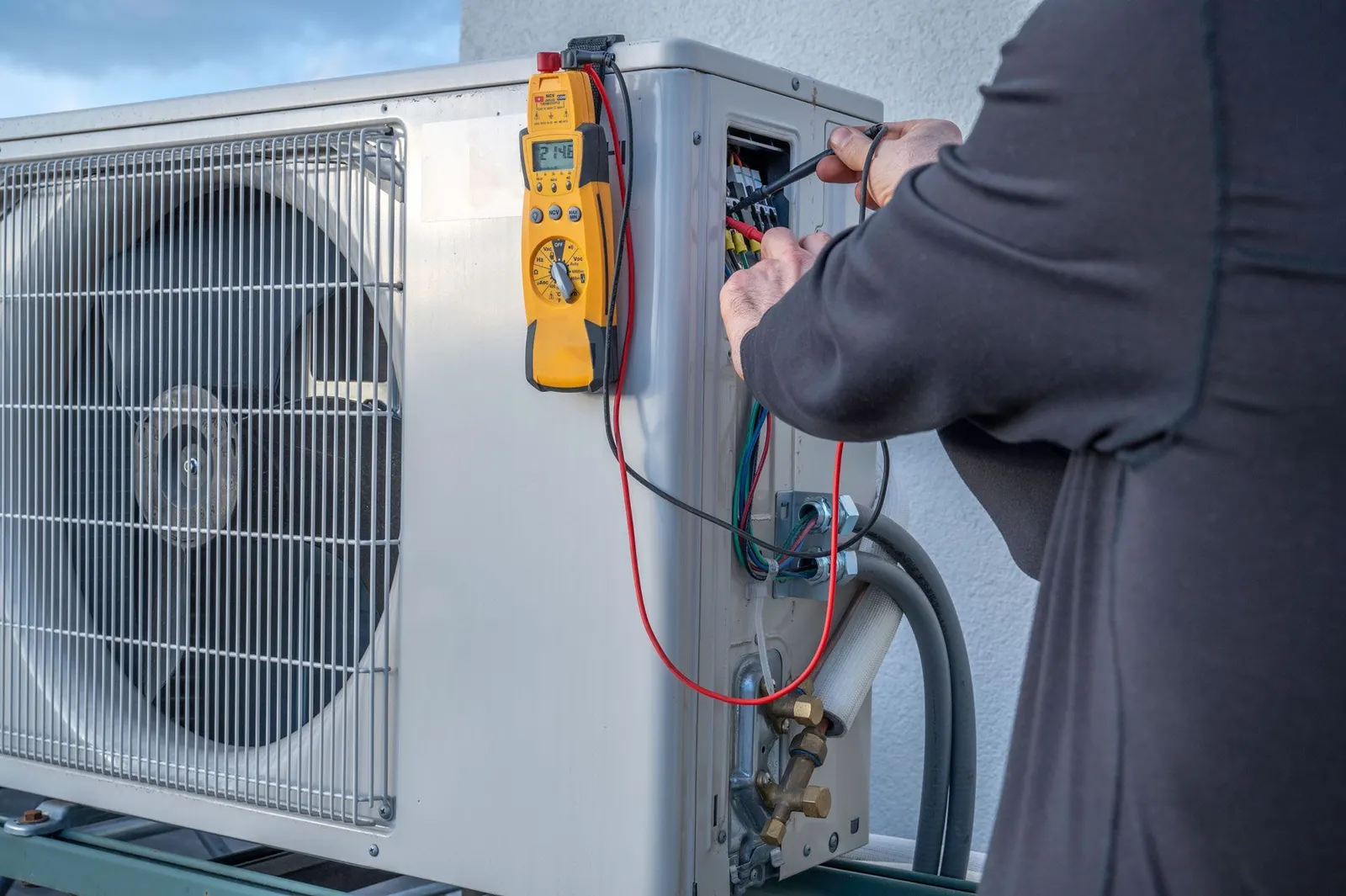
- The Evaporator (Outdoor Coil in Winter): This is where the refrigerant absorbs heat from the environment and evaporates into a gas.
- The Compressor: Often called the “heart” of the system, this unit squeezes the refrigerant gas. Basic physics tells us that when you compress a gas, its temperature and pressure skyrocket.
- The Condenser (Indoor Coil in Winter): The hot, pressurized gas flows through this coil. As indoor air blows across it, the refrigerant releases its heat and condenses back into a liquid.
- The Expansion Valve: This component acts like a nozzle, suddenly dropping the pressure of the liquid refrigerant. This causes the temperature to plummet, preparing it to go back outside and absorb more heat.
The “secret weapon” of a heat pump is the reversing valve. This is the component that allows the system to switch between heating and cooling by simply changing the direction the refrigerant flows.
To ensure these complex parts stay in top shape, we recommend our Service Plans to prevent breakdowns with regular HVAC service.
“How does a heat pump work in the winter to extract heat from freezing air?”
It sounds impossible—how do you get heat out of 30-degree air? The answer lies in thermodynamics. Even “cold” air contains a significant amount of heat energy (unless you reach absolute zero, which is -459°F).
In the winter, the outdoor unit acts as the evaporator. The refrigerant inside the coils is kept at a temperature much colder than the outdoor air. Because heat naturally moves from “warmer” areas to “colder” areas, the 30-degree air actually “warms” the refrigerant, causing it to boil into a gas.
This gas then travels to the compressor, which cranks up the heat through intense pressure. By the time that gas reaches your indoor unit, it’s hot enough to warm your home to a toasty 72 degrees. If you’ve ever noticed your furnace not heating properly, it might be time to consider how a heat pump’s consistent, even heat distribution could solve those cold spots.
“How does a heat pump work in the summer compared to a standard AC?”
In the summer, your heat pump essentially “forgets” it’s a heater and starts acting exactly like a high-efficiency central air conditioner. The reversing valve shifts, and the cycle runs the other way.
Now, the indoor coil becomes the evaporator. It absorbs the heat from your indoor air, making the room feel cool and crisp. The refrigerant carries that absorbed heat to the outdoor unit (now the condenser), where it is squeezed and released into the outdoor air.
Because heat pumps are designed for both roles, they often feature more advanced fan and compressor technology than entry-level AC units. This means you often get better dehumidification and quieter operation during those humid July afternoons in Martinsburg and Shepherdstown.
Check out our full range of Cooling Services to keep your home chilled all summer long.
Efficiency Metrics: COP, HSPF2, and Performance in the Mid-Atlantic
When comparing systems, you’ll see several acronyms. The most important for understanding how does a heat pump work in terms of efficiency is the Coefficient of Performance (COP).
COP is a simple ratio: (Heat Output) / (Energy Input). A traditional electric heater has a COP of 1.0. Most modern heat pumps have a COP between 3.0 and 5.0. This means you get 3 to 5 units of heat for every 1 unit of electricity you pay for.
In April 2026, we also look at HSPF2 (Heating Seasonal Performance Factor) and SEER2 (Seasonal Energy Efficiency Ratio). Higher numbers mean better efficiency. For our region, we typically recommend systems with an HSPF2 of 8–10 and a SEER2 of 14–18.
| Feature | Heat Pump | Gas Furnace | Electric Resistance |
|---|---|---|---|
| Energy Source | Electricity | Natural Gas/Propane | Electricity |
| Efficiency (COP) | 3.0 – 5.0 | 0.90 – 0.98 | 1.0 |
| Function | Heating & Cooling | Heating Only | Heating Only |
| Emission Level | Low (Zero local emissions) | Moderate to High | Low (depends on grid) |
| Ideal Climate | Moderate to Cold | Extreme Cold | Indoor/Small Spaces |
A common myth is that heat pumps stop working when it gets really cold. While it’s true that efficiency drops as the temperature difference between inside and outside grows, modern “cold-climate” heat pumps can operate effectively down to -22°F. For the rare “polar vortex” days in Shippensburg or Berkeley Springs, many homeowners opt for a “dual-fuel” system—a heat pump paired with a gas furnace backup for maximum peace of mind.
Regardless of the system you choose, the benefits of regular HVAC service cannot be overstated for maintaining these high efficiency ratings.
Choosing Your System: Types, Costs, and 2026 Incentives
Not all heat pumps are created equal. Depending on your property in Frederick or Harpers Ferry, one of these three types will likely be the best fit:
- Air-Source Heat Pumps (ASHP): The most common residential type. They extract heat from the air and are relatively easy to install using existing ductwork.
- Ground-Source (Geothermal) Heat Pumps: These use the stable temperature of the earth (usually around 55°F) via buried pipes. While the installation cost is higher, they offer the highest COP (up to 6.0) and incredible longevity.
- Ductless Mini-Splits: Perfect for older homes in Charles Town or Shepherdstown that don’t have ductwork. They use small indoor “heads” mounted on walls to provide zoned comfort.
As of 2026, the transition to eco-friendly home comfort is more affordable than ever. Federal tax credits and local utility rebates in Maryland and Pennsylvania can often cover a significant portion of the installation. Furthermore, the industry has moved toward low-GWP (Global Warming Potential) refrigerants like R32 and R290 (propane), which are much safer for the environment if a leak ever occurs.
Explore our comprehensive HVAC Services to find the perfect match for your home’s layout.
Frequently Asked Questions about Heat Pump Mechanics
Do heat pumps work in freezing temperatures?
Yes! While older models struggled below 32°F, modern cold-climate heat pumps use variable-speed compressors to extract heat even when it’s well below zero. In the Mid-Atlantic, they are effective for nearly 99% of our winter hours.
How long do heat pump systems typically last?
With proper maintenance, a standard air-source heat pump lasts between 10 and 25 years. Ground-source units can last even longer, with the indoor components lasting 25 years and the underground loops lasting 50+ years.
Are heat pumps more expensive to install than furnaces?
The upfront cost for a heat pump is generally higher than a standalone furnace, but you have to remember you are buying both a heating and a cooling system in one. When you factor in the energy savings (up to $1,000 annually) and available tax credits, the “payback period” is often quite short.
Conclusion
Understanding how does a heat pump work is the first step toward a more comfortable, efficient, and sustainable home. By moving heat rather than creating it, these systems offer a level of performance that was once thought impossible in colder climates.
At Comfort Central Inc, we’ve been a family-owned staple in the community since 2006. Whether you are in Hagerstown, MD, Martinsburg, WV, or Chambersburg, PA, our licensed and insured technicians are here to ensure your family stays comfortable regardless of the weather outside. We pride ourselves on fair pricing, expert service, and a neighborly approach to HVAC.
Ready to see how much you could save with a modern heat pump? Schedule your heating services today and let us help you find the perfect comfort solution for your home.